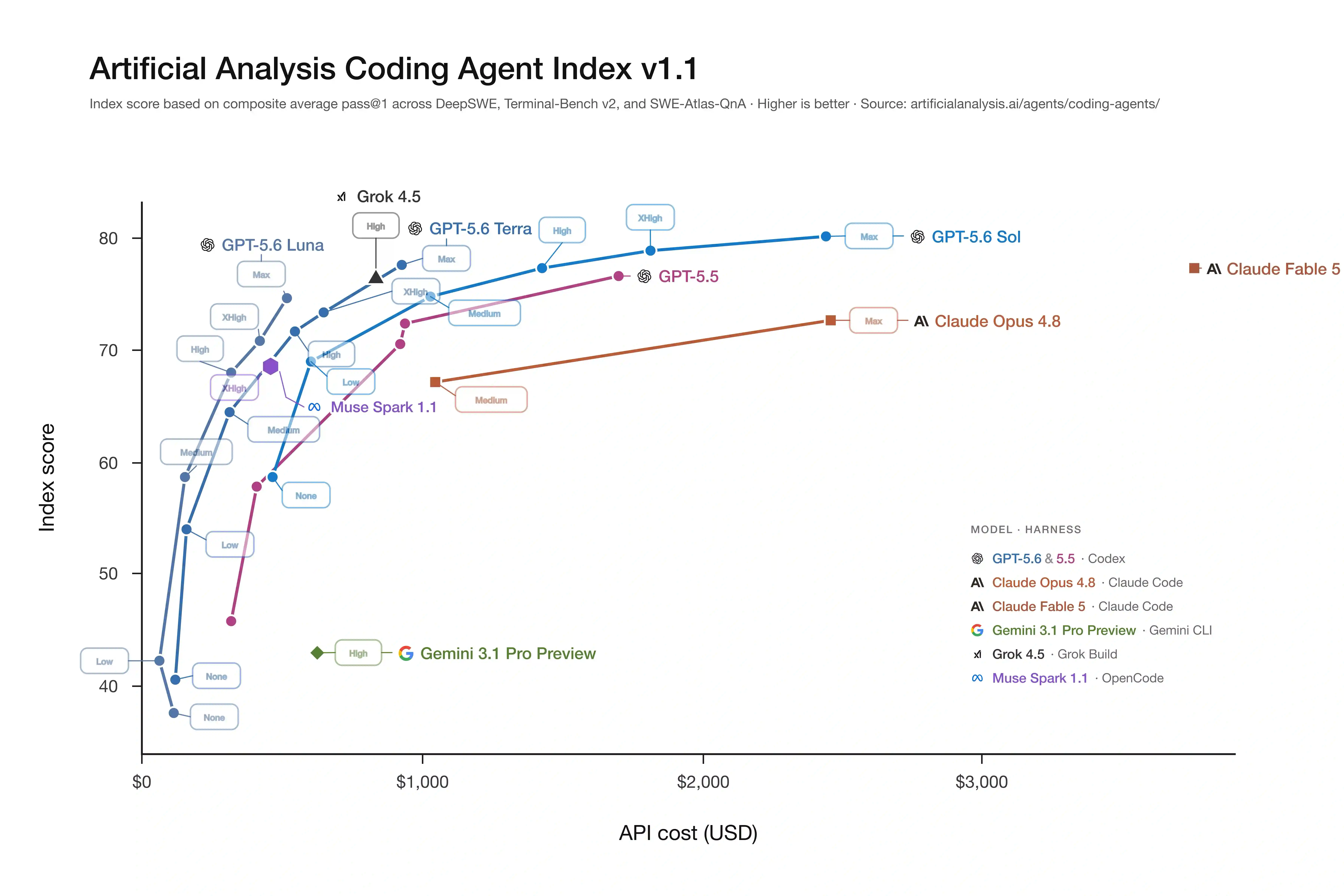
GPT-5.6 can be configured in dozens of ways, and the largest model is not automatically the best economic choice.
Machine-learning educator Sebastian Raschka counted 72 possible combinations across ChatGPT Work and Codex, the Sol, Terra, and Luna tiers, six reasoning levels, and Standard or Fast execution. His comparison highlights an increasingly important pattern: a smaller model using more reasoning can land on a better cost-performance frontier than a larger model using less reasoning.
For engineering teams, that turns model selection into an optimization problem.
Why “largest available model” is a weak default
A larger model can solve more difficult tasks, but production cost is determined by more than the list price per token.
Total task cost includes:
model input + model output + cached context + tool calls
+ retries + verification + human review + failure recovery
A cheaper model that fails twice may cost more than an expensive model that succeeds once. A flagship model that overthinks a simple request may also produce unnecessary latency and output. The only reliable comparison is made on the complete workflow.
The Luna high-effort pattern
In Raschka’s chart, Luna at a high reasoning setting appears on an attractive part of the coding-agent efficiency frontier. A larger model at medium effort does not automatically dominate it.
This does not mean Luna is universally equal to Sol. Public benchmarks combine particular harnesses, task distributions, time limits, and scoring rules. A configuration that performs well on coding-agent tests may not be the right choice for legal review, visual design, cyber analysis, or long-context synthesis.
The transferable lesson is the order of experimentation:
- Establish a small-model baseline.
- Increase its reasoning effort.
- Measure the change in accepted-task rate and total cost.
- Move to a larger tier only if the task still misses its target.
Build a configuration matrix
Do not test all 72 combinations. Start with configurations that answer a clear question.
| Candidate | Question it answers |
|---|---|
| Luna medium | What is the low-cost baseline? |
| Luna high or xhigh | Does more reasoning fix the baseline’s failures? |
| Terra medium | Does model scale help more than extra reasoning? |
| Sol medium | What does a flagship baseline add? |
| Sol max | What is the quality ceiling for this task? |
Run each candidate on the same versioned evaluation set. Randomize task order where possible, hold tool permissions constant, and record more than the final score.
Metrics that matter
Accepted-task rate: The percentage of outputs that can be used without material correction.
Cost per accepted task: Total inference and tool cost divided by accepted outcomes, including retries.
Time to accepted task: Latency plus human review and reruns.
Change precision: For coding agents, how often the model changes only the files and behavior required.
Recovery rate: Whether the agent notices failed tests or bad tool output and corrects course.
Tail risk: The frequency and cost of rare but severe failures. An average score can hide these.
Subscription quotas and API costs are different systems
Developers should not infer API economics from a consumer subscription. A ChatGPT or coding-product plan may bundle usage, apply quotas, or restrict certain effort levels. API billing is based on metered tokens and related features.
That difference matters when a prototype moves into production. An interactive tool can feel inexpensive under a flat subscription while the same workflow creates a large API bill at scale. Conversely, a carefully cached API workflow may be cheaper than expected.
Keep two dashboards: one for developer-product usage and another for production API unit economics.
A routing rule that can survive model updates
Hard-coding a model name into business logic makes every release disruptive. Route by task class and service level instead.
For example:
fast_extract     -> lowest-cost model passing extraction evals
code_change      -> best cost per merged change under 10 minutes
deep_research    -> highest source-grounded score under the budget
critical_review  -> strongest model plus independent verification
The selected model can then change without rewriting the product. Re-run the evaluation when a provider updates a model, price, cache policy, or reasoning behavior.
The signal
The age of one default model is ending. The durable capability is an evaluation harness that can identify the cheapest configuration meeting a defined standard.
The winning team will not be the one that always buys the largest model. It will be the one that knows exactly when the larger model changes the outcome.