Phaser Studio is turning the prompt-to-game demo into an actual development pipeline.
On July 8, Phaser released an MCP connection for Phaser Game Agent. Developers can connect it to Codex, Claude Code, Cursor, Copilot, Gemini CLI, Windsurf, and other compatible tools, describe a game, and receive a playable preview with generated code, art, and music.
The setup is designed to happen through the coding agent the developer already uses. Phaser says the agent can open a project, assemble the game in a private cloud workspace, verify the result, publish a preview, and return a shareable URL.
The service starts at $0.01 per build minute. Projects can later be exported for the web, Windows, macOS, or Linux.
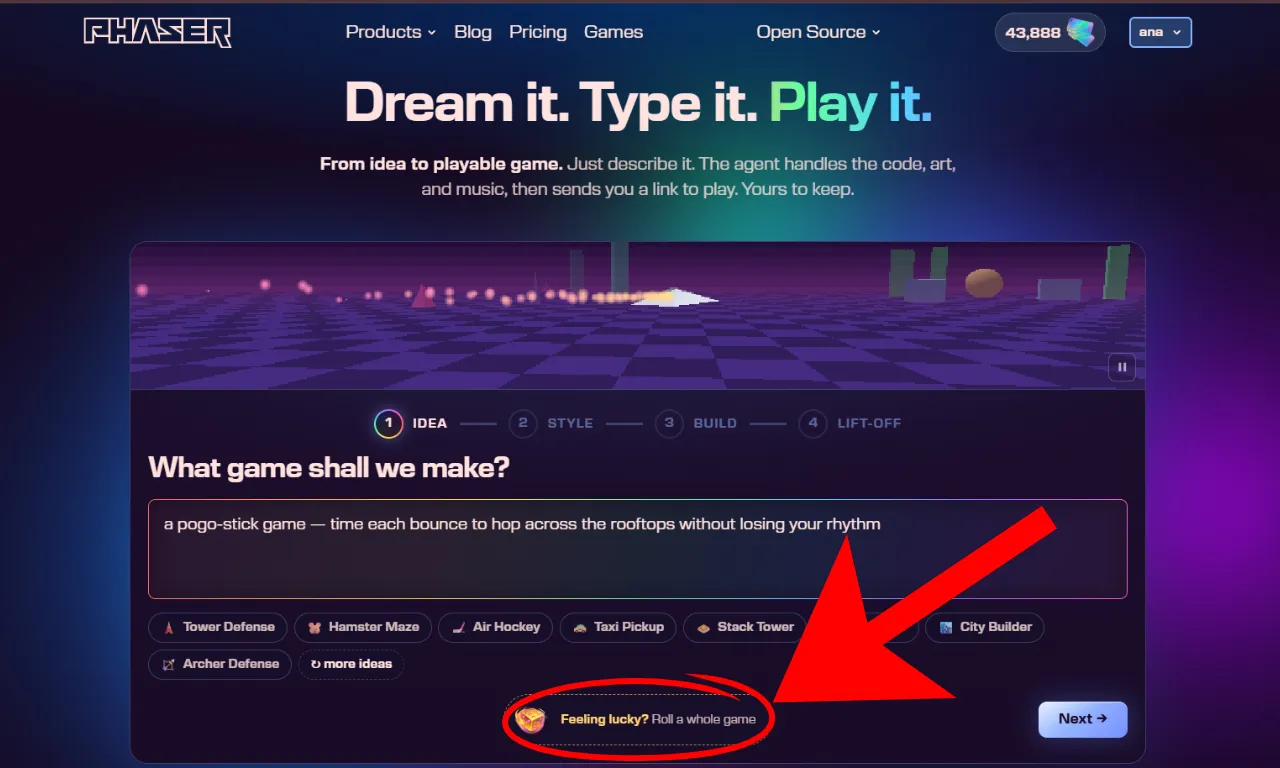
Figure: Phaser’s web flow turns a short game description into a scoped build request before handing work to the agent. Source: Phaser.
The interesting part is not the one-sentence prompt
“Build a game from one sentence” is an effective headline, but the internal architecture is more important than the input length.
General coding agents often struggle with game engines because those engines expose large APIs built for human developers. A person can learn how collision bodies, cameras, tweens, asset loaders, and scene lifecycles fit together. A model sees a wide surface of similar functions and can invent plausible but invalid combinations.
Phaser responded by building Phaser AE, an arcade engine whose API is organized around gameplay intentions. Instead of forcing an agent to translate “the enemy loops around the player” into low-level renderer and physics operations, the engine exposes smaller components and behaviors that more closely match how a prompt describes a game.
The approach reduces the amount of engine state the model must hold in context. Known difficult operations, including collision handling, input, and object pooling, can remain behind tested components.
Reuse is doing more work than generation
Phaser’s technical write-up describes game manifests and a library of reusable capability blocks. A familiar shooter is decomposed into pieces such as player flight, scrolling terrain, enemy waves, power-up systems, and bosses.
The agent searches for capabilities rather than copying an entire named game. When a tested component already exists, it reuses the implementation and focuses generation on the glue and configuration that make the new game distinct.
This resembles a production software agent more than a single model producing a large code file:
natural-language game idea
  -> structural game manifest
  -> retrieve tested mechanics and components
  -> generate missing code and procedural assets
  -> run mechanics in isolated test rigs
  -> assemble the complete game
  -> run acceptance checks
  -> publish a playable preview
The quality improvement comes from narrowing the model’s decisions, not simply increasing model size.
Sandboxes make autonomous building safer
Each Game Agent conversation runs inside an isolated Superserve virtual machine with the project scaffold, toolchain, and engine already installed. The build environment can read from Phaser’s component library but cannot publish new shared components back into it without a separate controlled process.
That isolation matters because a game-building agent must execute generated code, install dependencies, create files, and run development servers. Giving the same permissions directly on a developer’s workstation would create a much larger security boundary.
Prebuilt environments also save tokens. The agent does not need to spend the start of every session discovering package versions, fixing a toolchain, or reconstructing the same project layout.
What the agent generates
Phaser says the system creates:
- Game code and mechanics.
- Procedural sprites and tiles.
- Sound effects.
- A chiptune soundtrack.
- Automated checks for expected behavior.
- A hosted preview URL.
The generated aesthetic is intentionally suited to browser-based and retro-style games. That is a practical scope choice. A complete 2D arcade loop can be tested and shared quickly, while a high-fidelity 3D game requires an entirely different asset, animation, performance, and quality-control pipeline.
Developers should therefore interpret “complete game” as a playable scoped project, not evidence that a sentence can replace a full commercial studio.
Automated tests cannot decide whether a game feels good
Phaser’s own process includes a human playtest after automated checks pass. A test can verify that a projectile damages an enemy or a score counter increments. It cannot reliably decide whether movement feels responsive, a landscape scrolls smoothly, visual hierarchy is clear, or a level is enjoyable after ten minutes.
This is an important limit for every prompt-to-game system. Software correctness is necessary, but games are evaluated through timing, feedback, difficulty, art direction, and surprise. Those qualities require repeated observation and adjustment.
The useful role of the agent is to compress the distance between an idea and the first playable build. It can also make iteration cheaper by changing mechanics that already run inside a consistent harness.
Why MCP changes the workflow
The web interface can build a game from a description, but MCP lets the game service become one tool inside a larger development agent.
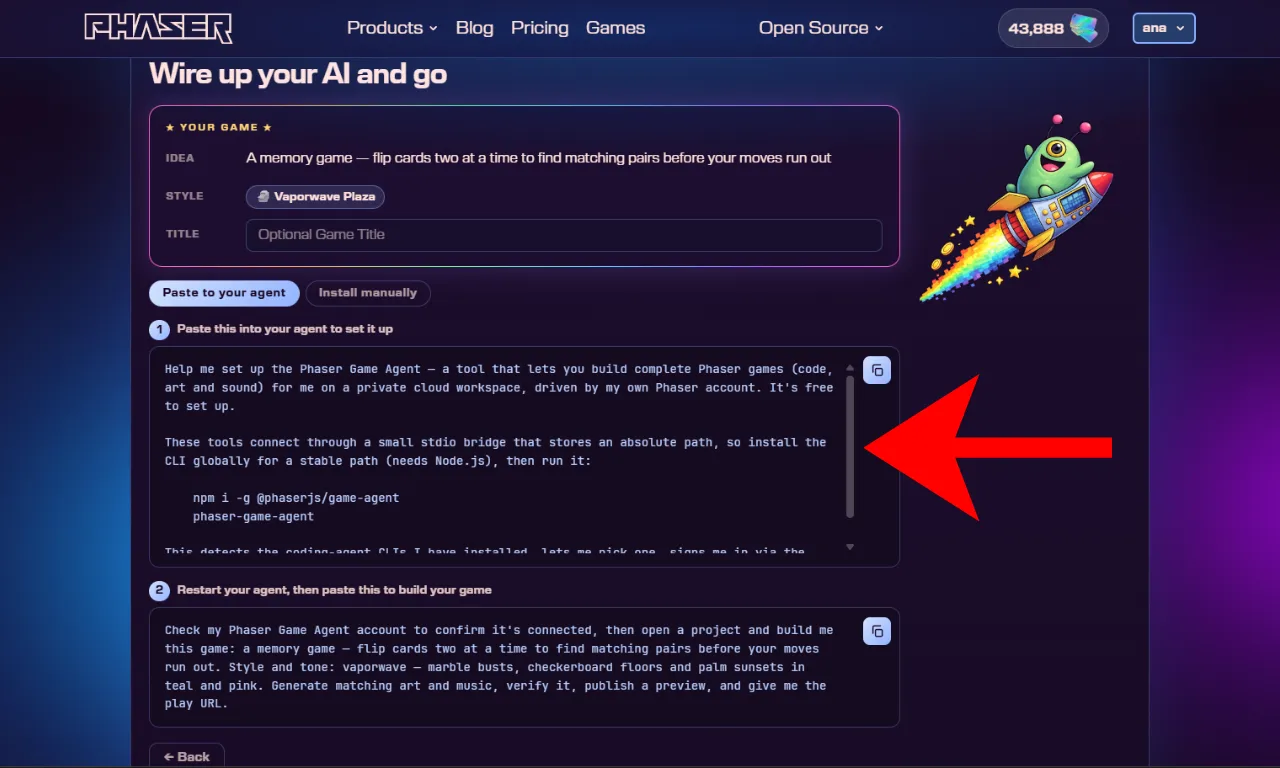
Figure: The official setup flow generates prompts that install the bridge and pass the selected game specification to a coding agent. Source: Phaser.
A developer could ask an agent to inspect an existing repository, create a prototype based on a product requirement, run the Phaser build, review the output, and then integrate selected code into a broader application. The conversation can include source files, issue context, and follow-up edits instead of starting from an isolated prompt box.
That makes Phaser Game Agent relevant to professional prototyping even if its first output is not shippable. Teams can test an interaction, ad concept, tutorial, or game mechanic before committing artists and engineers to a production implementation.
Questions to test before depending on it
Developers evaluating the service should measure:
- Time from prompt to first playable build.
- Percentage of builds that pass without manual repair.
- Cost per accepted prototype rather than cost per minute.
- Ease of editing the exported code without the agent.
- Originality and licensing status of generated assets.
- Accessibility, mobile input, and performance of the result.
- How well the system handles a second and third iteration.
A spectacular first demo is less valuable than a project that remains understandable after export.
The signal
Phaser Game Agent shows where AI coding tools are heading: specialized engines, constrained APIs, tested component libraries, isolated execution, and artifacts that users can run immediately.
The model still matters, but the product advantage comes from the system surrounding it. The winner in AI-assisted game development may not be the agent that writes the most code. It may be the one that reaches a playable, editable result with the fewest unverified decisions.