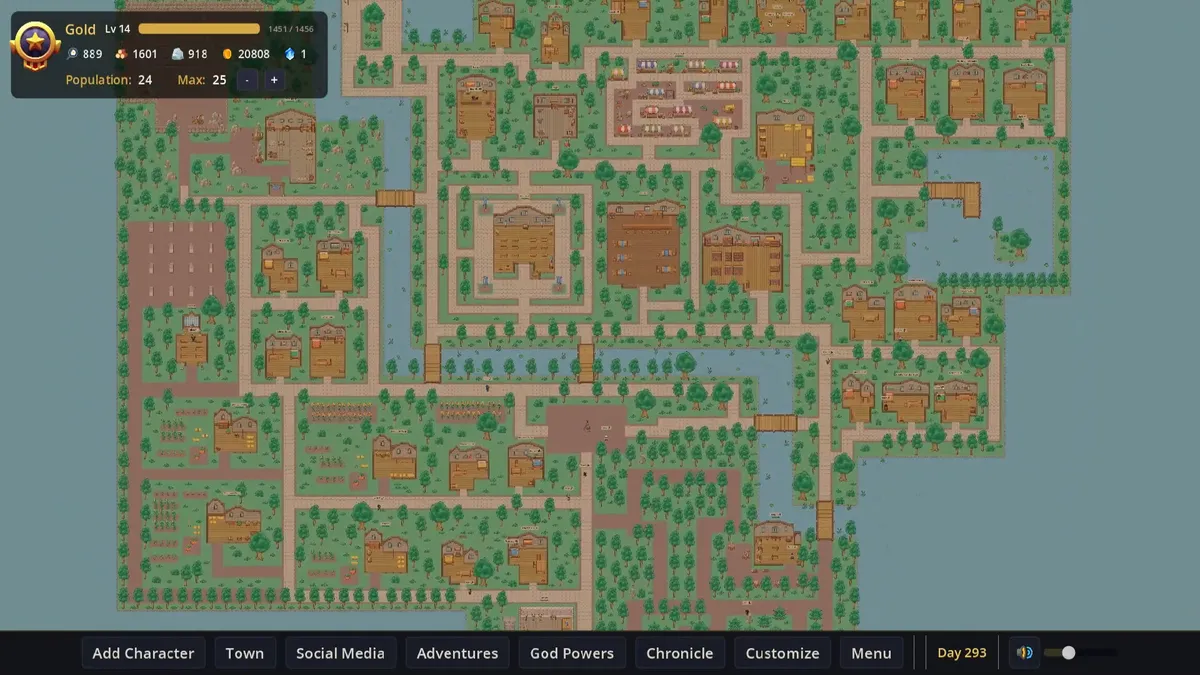
AI Society asks a direct question: what happens when every resident in a colony simulation can make decisions through a local language model?
Released on Steam on March 20, 2026, the game lets players create up to 25 characters with personality traits, hobbies, appearances, and free-form backstories. The residents work, spend money, form relationships, argue, marry, have children, post on an in-game social feed, fight, and react to player interventions.
The generative behavior runs through Ollama or LM Studio on the player’s own machine. No cloud API or monthly AI subscription is required.
Every character receives a model-driven identity
The player configures traits along several behavioral dimensions, including peaceful versus aggressive, hardworking versus lazy, extroverted versus introverted, generous versus selfish, and playful versus serious.
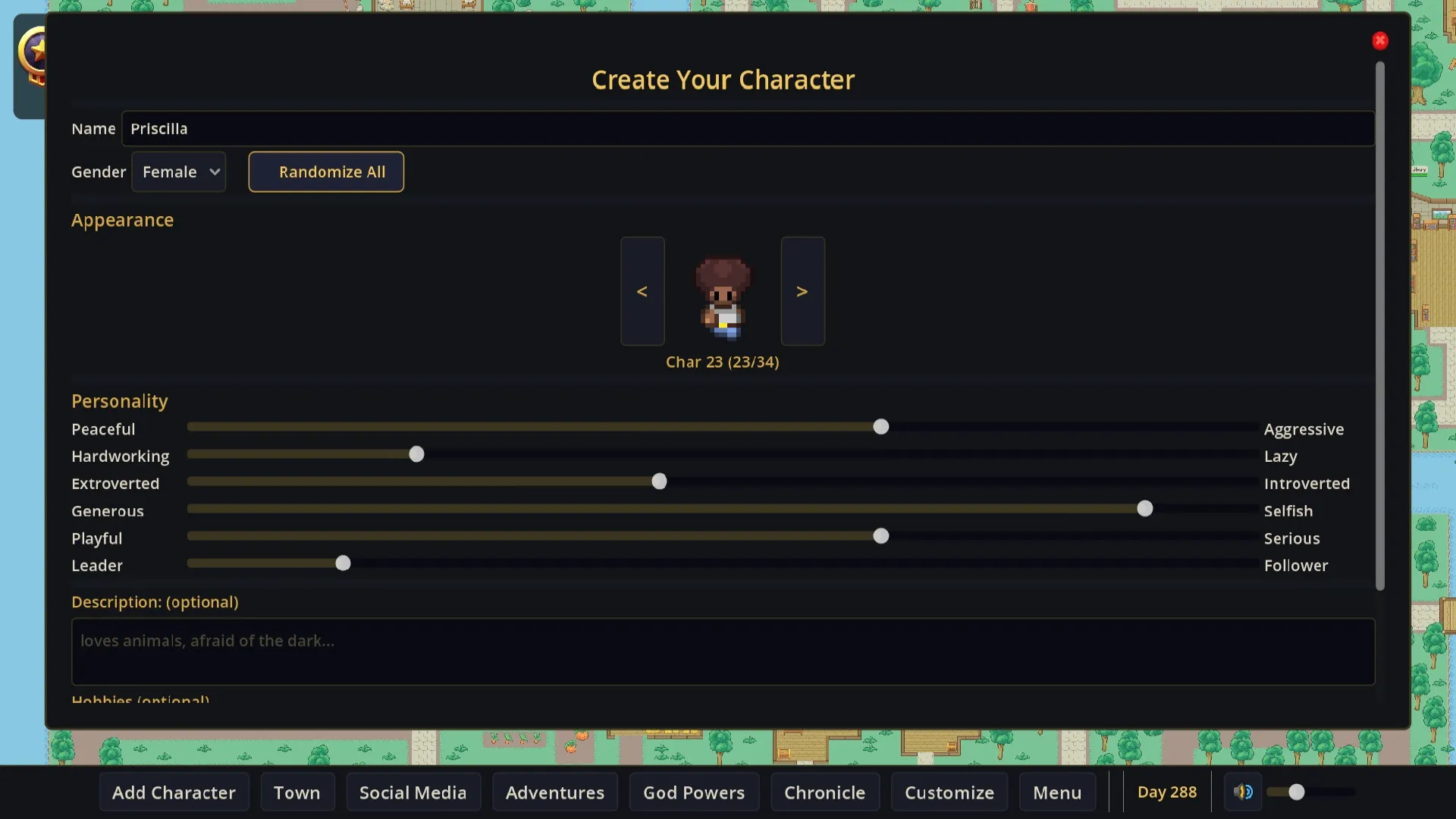
Figure: Character creation combines deterministic trait sliders with a free-form description used to shape model-driven behavior. Source: Steam.
A free-form description can add a worldview or backstory, while hobbies and jobs connect the character to the settlement’s economy. AI Society uses these inputs to generate daily routines, dialogue, relationship choices, reactions, and social posts.
The important design choice is that character identity is not limited to a dialogue box. A model output can affect visible behavior in the simulated town. Residents choose jobs, visit neighbors, gather at the tavern, confront rivals, participate in raids, and leave gaps in the economy when they die.
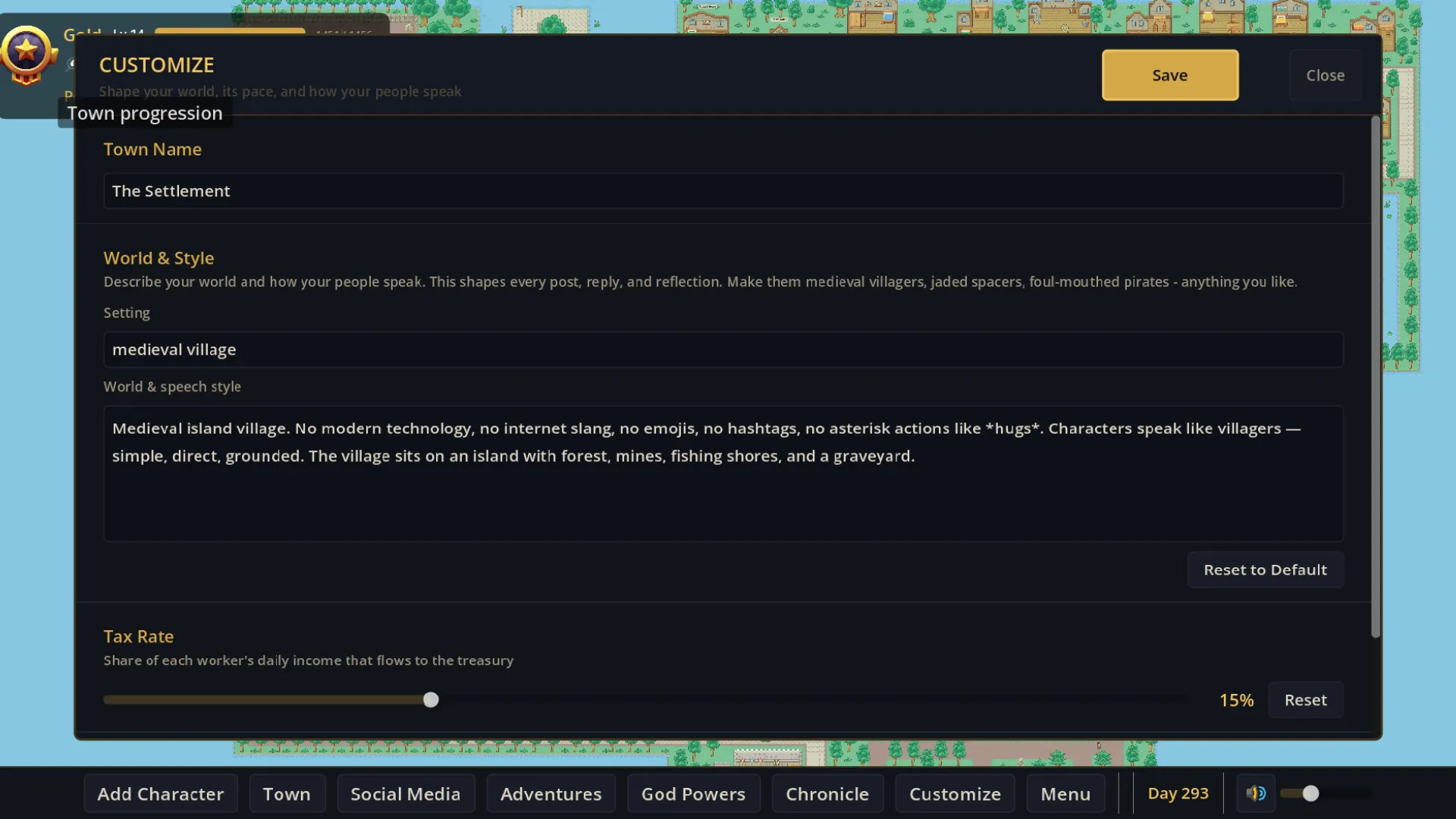
Figure: Players can prompt the world’s setting and speech style while conventional controls define systems such as taxation. Source: Steam.
Ollama makes the model replaceable
AI Society lists several supported local model options:
- Llama 3.2 1B for lighter hardware.
- Llama 3.1 8B for deeper character behavior.
- Gemma 2 2B as another lightweight option.
Because Ollama and LM Studio expose common local inference workflows, players are not permanently tied to one hosted model. The Steam description says every conversation, social post, and character decision is generated live by the selected model.
This flexibility is valuable for experimentation, but it creates a difficult support matrix. Different models can interpret personality prompts differently, produce responses at different speeds, and require different amounts of memory. A save file that feels coherent under an 8B model may behave differently after switching to a smaller one.
The game therefore acts as both a simulation and an informal model benchmark. Players can observe which model maintains character identity, references prior events, and makes decisions that fit the town state.
Local AI removes the token meter
Cloud-hosted AI games often have to limit conversation time, sell additional credits, or absorb an unpredictable inference bill. A civilization simulation amplifies that problem because multiple characters may need decisions even when the player is not directly talking to them.
Local execution changes the economics. The developer sells the game while the player’s hardware performs the inference. Conversations can continue without a vendor API, and private role-play data stays on the device.
The cost appears elsewhere. AI Society recommends 16 GB of system memory and 8 GB of VRAM, while its minimum specification lists 4 GB of VRAM. Lower-end systems may need a smaller model or slower CPU inference.
The number of active characters also creates a scheduling challenge. Running 25 simultaneous model calls would waste memory and hurt frame rate. A practical simulation must queue decisions, summarize state, limit context, and decide which events deserve model attention.
This is an AI-native design, not only AI-generated content
The strongest definition of an AI-native game asks whether removing runtime generative AI would collapse or fundamentally change the core form of play.
AI Society meets that test more convincingly than a game that used an image model for concept art. Its central promise is observing residents create unpredictable social behavior from their personalities and shared history. Replacing those decisions with a small fixed dialogue tree would produce a different experience.
That does not guarantee that the experience is good. Runtime generation still needs mechanical structure:
- Characters need resources and jobs that matter.
- Relationships need persistent state.
- Decisions need visible consequences.
- The player needs understandable ways to intervene.
- Generated text needs to reference events that actually happened.
Without those constraints, the result becomes a collection of chatbots talking near a city-building interface.
The mixed reception is part of the story
As of July 14, AI Society has a small sample of Steam reviews with a Mixed overall rating. That should not be treated as a final verdict, but it is a useful warning against evaluating AI games only from a feature list.
Players experience latency, repetition, interface friction, unclear goals, and simulation depth. A model can generate endless dialogue while the game around it still feels shallow. Conversely, a rough indie project can reveal a mechanic that larger studios later refine.
The useful question is not whether every resident can produce a unique sentence. It is whether those sentences cause relationships, economic changes, conflicts, or stories the player can understand and influence.
What developers can learn from it
AI Society exposes several design decisions that future simulation games will need to make:
- Model scope: Decide which character actions require generative reasoning and which should remain ordinary simulation rules.
- Context scope: Give each character enough memory to stay coherent without replaying the entire town history on every turn.
- Scheduling: Prioritize model calls around visible or consequential events.
- State validation: Prevent generated decisions from violating inventory, location, relationship, or quest constraints.
- Fallbacks: Keep the game playable when a model is slow, unavailable, or produces invalid output.
- Observability: Show players why a character acted, not only the final animation.
These are systems-engineering problems as much as narrative design problems.
The signal
AI Society is not evidence that local LLMs have solved believable virtual societies. It is evidence that developers can now ship a commercial simulation in which dozens of characters use replaceable models on consumer hardware.
The next step for AI-native games is not simply adding more generated dialogue. It is making model decisions legible, consequential, and stable enough that players care about the society that emerges.