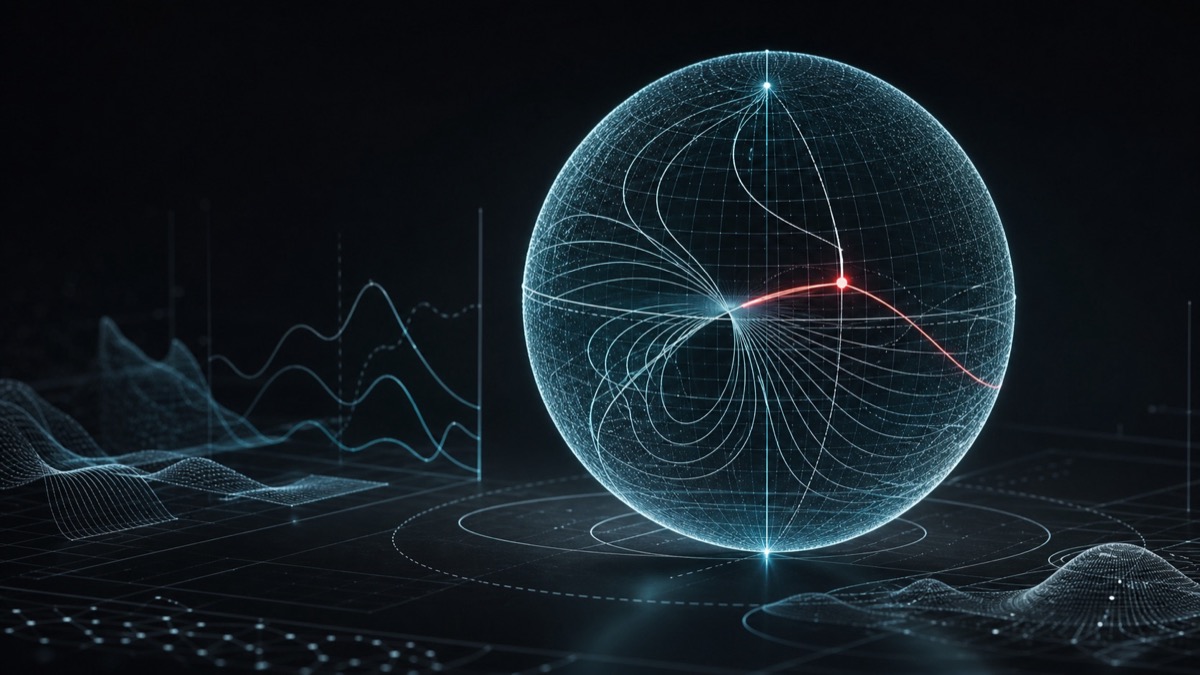
An explicit counterexample reportedly produced by Grok 4.5 may have closed a small but meaningful gap in functional analysis: whether a sharp hypercontractivity condition for the Poisson semigroup continues to hold on the four-dimensional sphere.
The result is unusually interesting because it is concrete. It is not a model proposing a vague proof strategy or repeating a known theorem. Paata Ivanisvili, one of the authors of the original 2021 result, said the model generated a simple counterexample on the 4-sphere and that he checked it. He also said the files were produced without intervention during the model run.
That is strong early evidence. It is not the same as a peer-reviewed result, an independent paper, or broad verification by specialists. For now, the accurate description is a researcher-checked candidate counterexample.
The five-year gap
In 2021, Rupert Frank and Paata Ivanisvili studied the Poisson semigroup
exp(-t sqrt(-Delta))on the sphere. Hypercontractivity, informally, describes how an operator can smooth a function strongly enough to improve its integrability. The property appears in analysis, probability, information theory, and the study of stochastic processes.
Frank and Ivanisvili proved the expected sharp condition in dimensions three and below. They also showed that the same equivalence fails in sufficiently large dimensions, with dimension 13 available as an explicit example.
That left dimensions 4 through 12 unresolved. The new model-produced construction targets the first unknown case, dimension 4. If it survives scrutiny, the earlier theorem becomes sharp: the condition holds through dimension 3 and already fails in dimension 4.
Why an explicit counterexample matters
An existence claim can hide substantial complexity. An explicit counterexample gives reviewers a specific mathematical object to substitute into the relevant inequalities and test.
That changes the verification burden. Reviewers do not have to trust the model’s narrative or reconstruct an open-ended search. They can check the proposed function, parameters, expansions, and inequalities line by line.
The simplicity of the construction also matters. A short example is easier to audit, formalize, and compare with the proof techniques in the 2021 paper. It may reveal which structural feature changes between dimensions 3 and 4 rather than merely showing that a numerical search found a failure.
What has been verified so far
The public evidence supports four limited claims:
- The 2021 paper established the low-dimensional result and failure in large dimensions.
- Ivanisvili publicly described an explicit Grok 4.5 construction for the 4-sphere.
- He said he checked the example and found it valid.
- No peer-reviewed paper or independent formal verification was linked at publication time.
The fourth point should stay attached to every headline about the result. Mathematical validity does not depend on who or what generated the argument, but a major claim becomes durable through reproducible checking.
This is a better AI-math test than benchmark scoring
Frontier models routinely post high scores on curated mathematics benchmarks. Those tests are useful, but their questions, answer formats, and evaluation procedures are known in advance. A live research problem is different.
This case tests several capabilities at once:
- Reading and correctly using a specialized theorem.
- Identifying the unresolved boundary of a result.
- Searching for a construction rather than producing a generic proof sketch.
- Returning an object that a domain expert can directly test.
- Keeping the final argument simple enough to audit.
The important output is not eloquent mathematical prose. It is a new, checkable object.
The reproducibility questions
Before treating the problem as closed, researchers should be able to answer:
- What exact prompt and model build were used?
- Was the model given the 2021 paper, intermediate lemmas, or failed attempts?
- Can the calculation be reproduced from the released files?
- Do independent analysts obtain the same inequality failure?
- Can a proof assistant or symbolic system verify the critical algebra?
- Did the model rediscover an unpublished or obscure construction already present elsewhere?
Ivanisvili also reported that another frontier model found a counterexample. If both systems reached related constructions independently, that would strengthen the scientific story. It would also make disclosure of prompts and intermediate assumptions more valuable.
The signal
The most credible version of this story is narrower than “AI solved mathematics.” A frontier model appears to have generated an explicit object that sharpens a published theorem, and an author of that theorem says the object checks out.
If independent review confirms the result, the milestone will be less about replacing mathematicians and more about changing the search loop. A model can explore candidate constructions quickly; a specialist can recognize significance, check the decisive step, and turn a raw output into mathematics the community can trust.